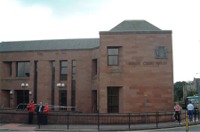
What I did at court today …

A small claims proof re: property factors fees.  The result?  A score draw, I’d say.

Well outside my comfort zone, as I’ve not practised anything but education law for a number of years now and with only 24 hours notice – so I was quite pleased all things considered!

Posted in Glasgow, Law Centres | Tagged , , | Leave a comment

Devices to deter drug drivers?

My latest post on the Yell.com solicitors’ blog is now available.  It’s called: “Devices to detect drug driving“.  A quote:

At the moment, if police suspect a driver of drug driving, they may use a Field Impairment Test, such as Romberg’s test (which, basically involves trying to keep your balance with both feet firmly together, eyes closed and counting to 30 seconds in your head). Fail this, and you’ll be arrested and taken in.

Please enjoy Absolvitor responsibly.

Posted in Criminal Law, Yell.com Solicitors Blog | Tagged , | Leave a comment

Great lovers, great training day.

Interesting training session today.  It turns out that the emphasis and the way you say something can totally change its meaning.

For example, compare:

She said you were a great lover.

and

She said you were a great lover.

More tomorrow.

Posted in Faculty of Advocates, Just for Fun, Law Centres | Leave a comment

Govanhill Times

From tonight’s Evening Times:

“Lawyer Lorraine Barrie, from Govanhill Law Centre, has been vital in helping local people seek redress from cowboy landlords and factors.”

Damn straight she has.

Posted in Glasgow, Law Centres, News | Tagged | Leave a comment

Good old fashioned penny pinching

At the risk of sounding like Jeremy Clarkson, let me add my voice to the chorus of disbelief surrounding the untimely death of solicitor Alison Hume.

In 2008, while taking a short-cut home, she fell down a 40ft disused mineshaft near Galston, Ayrshire. She lay for six hours at the bottom of the hole after “health and safety rules” stopped firefighters from rescuing her.

She then had a heart attack as she was being brought to the surface. The medical evidence seems to be that she died from a combination of hypothermia and chest injury but that she could have survived this if she had been brought to the surface earlier.

The Fatal Accident Inquiry at Kilmarnock Sheriff Court has been re-opened to hear the evidence of fire officer John Bowman.  His evidence was that he had been ordered (over his protests) to draft a memo restricting use of a new rescue kit for rescuing other firefighters, not members of the public.

The justification given was that wider use would require all firefighters to receive safe working at height training (and thus be paid at a higher rate).  Mr. Bowman’s evidence was that the memo was issued for economic reasons.

Without wishing to prejudge anything before Sheriff Leslie has issued his decision, it seems to me that it is all too easy to blame things on “health and safety” when actually it’s something else altogether.  Like good old fashioned penny pinching.

Posted in Health and Safety, News, Scottish Court Service | Tagged , | 1 Comment

RBS: Bank of Terror!

The Financial Services Authority (FSA) has fined members of the Royal Bank of Scotland Group (RBSG) £5.6 million for failing to have adequate systems and controls in place to prevent breaches of UK financial sanctions.

UK firms are prohibited from providing financial services to persons on the HM Treasury sanctions list. The Money Laundering Regulations 2007 (the Regulations) require that firms maintain appropriate policies and procedures in order to prevent funds or financial services being made available to those on the sanctions list.

Between 15 December 2007 and 31 December 2008, RBS Plc, NatWest, Ulster Bank and Coutts and Co, which are all members of RBSG, failed to adequately screen both their customers, and the payments they made and received, against the sanctions list. This resulted in an unacceptable risk that RBSG could have facilitated transactions involving sanctions targets, including terrorist financing.

The FSA considered that RBSG’s failings posed a risk to the integrity of the UK financial services sector as a whole. This is the biggest fine imposed by the FSA to date in pursuit of its financial crime objective. It is also the first fine imposed by the FSA under the Regulations.

Margaret Cole, FSA director of enforcement and financial crime, said:

“The involvement of UK financial institutions in providing funds, economic resources or financial services to designated persons on the sanctions list undermines the integrity of the UK’s financial services sector. By failing to screen relevant customers and payments against the HM Treasury sanctions list, RBSG left itself open to the risk that it was facilitating terrorist financing.

“The scale of the fine shows how seriously the FSA takes this issue and should act as a warning to other firms to ensure that they have adequate screening procedures.”

As RBSG agreed to settle at an early stage of the FSA investigation, it qualified for a 30% reduction in penalty. The FSA would have otherwise imposed a financial penalty of £8 million!

Posted in Edinburgh, News | Tagged , | 1 Comment

Too many twits…

Okay, so now I’m on twitter, what should I do now?

All suggestions welcomed.

Posted in Blawgs, Site Updates | Tagged | Leave a comment

Vote for me!

I’m sure it’s very bad form and all, but I couldn’t help noticing that the UK Blawg Awards 2010 nomination process was underway. I voted for Jonathan Mitchell QC as Best Legal Commentary, but if you felt like nominating Absolvitor for “Blawg of the Year” or something, then that’d be nice.

Here’s the link: Blawggies 2010

But, you know, only if you want to …

Posted in Blawgs | 4 Comments

You’re welcome!

Yesterday, I uncovered a bug in the SLAB online SU2 form.  Apparently, there is no cash reward for this.

Posted in Legal Aid | Tagged | Leave a comment

2010 Act – what is the point in you, exactly?

So, the first big test for the Scottish Government’s shiny new Schools (Consultation) (Scotland) Act 2010.  And how did it do?

Well, let’s start at the beginning.  Local authorities were closing schools because pupil rolls have been dropping over the years, which combined with a lack of proper maintenance of school buildings meant that it was costing lots of money to run some of them.

Including rural schools.  But campaigners, including groups like the Scottish Rural Schools Network, pointed out that a rural school was not just about the money – it was the hub of the community and closing schools sometimes posed a threat to the viability of a whole village.

So, the Scottish Government was elected on a manifesto promise to introduce a “legislative presumption against the closure of rural schools”.  And they duly passed the 2010 Act, stating that this fulfilled that promise, despite nowhere mentioning a presumption against closure.

Instead, there are some additional procedures and consultations to be gone through if you’re thinking about closing a rural school.  Which is fine, but certainly doesn’t look like a “legislative presumption against the closure of rural schools”.

So, SNP-run East Ayrshire Council decided to close little, rural, 52 pupil Crossroads Primary School.  And, in accordance with the new legislation, the parents asked the Scottish Government to “call in” the decision to consider whether to overturn it.  But the Government refused.

Let’s be clear, they didn’t refuse to overturn the decision – they decided not to call in and consider the Council’s decision at all, with a spokesperson stating that “it was satisfied the council’s decision had met its statutory obligations.”

To translate, the Council did the consultation process correctly, produced the right reports, and ticked the right boxes – so the Government won’t interfere.

Under the old rules, any closure proposal which would result in primary school children attending another school more than five miles away automatically had to be approved by the Scottish Ministers.  And the former Cabinet Secretary had form in this area, overturning the closure of 4 pupil Glentrool primary school.

So under the old rules, the closure of Crossroads Primary School (a rural school) would have been considered by the Scottish Ministers, but following the introduction of an Act designed to safeguard rural schools, the closure decision is not so considered.

Meanwhile, the current Cabinet Secretary went on the telly and was rude about the parents who opposed the closure of their children’s school.

Let’s compare and contrast:

“Access to a local school is particularly important in rural communities. We will introduce a legislative presumption against closure of rural schools and tighten the regulations for closing all schools.”

SNP Manifesto 2007

… and three years later …

“School closure decisions must be taken by those with the best knowledge of local circumstances and locally elected and accountable. Scottish ministers will only ever become involved when there is strong evidence that a council has failed to fulfil its obligations under the act.”

Scottish Government Spokesperson 2010

By the way, I think that the latter statement is all very well as a philosophy, except – that’s not what they said they were doing.  They said they were safeguarding rural schools and introducing a legislative presumption against the closure of rural schools.

And how can one tell, without calling in, that the Council has fulfilled its obligations?  The authority claimed it would cost over £1 Million to refurbish the school, while the parents had a quote for about half that amount.  How can Mike Russell tell that the authority are right and the parents are wrong without investigating or considering the case?

It is deeply ironic that, at least for Crossford Primary School, the whole safeguarding rural schools agenda actually left them with fewer safeguards than they would have had under the old rules.  With the budgetary pressures mounting on local government, rural schools should not expect any high profile Government interventions in their cases anytime soon.

One is left wondering what the point in the 2010 Act is at all?  As before, the best defence against the closure of a rural school is to have a hung Council where no one party has overall control.

Posted in Education Law, News, Scottish Government | Tagged , | Leave a comment