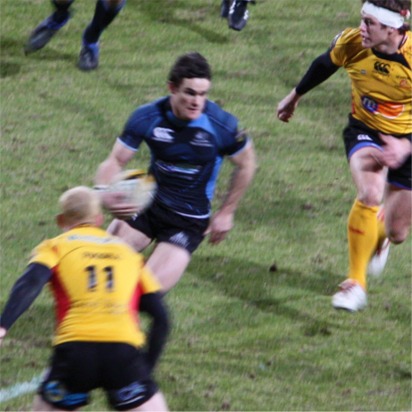
Max Evans has had a busy week

Max Evans has had a busy week.  Fresh from being acquitted by a jury of his peers at Edinburgh Sheriff Court, he received a yellow card in today’s Six Nations Ireland v. Scotland test match.

Earlier this week, a jury took less than an hour to decide that he did not assault a man in a nightclub by glassing him in the face.  Evan’s lawyer described him in court as “decent, measured, polite and honest”.

Fast forward to today’s yellow card, which was for bringing down Keith Earls off the ball.  Having being shown the card, Evans protested to the referee, saying “I didn’t even touch him.”, which subsequent video replays prove was not the case.

My 10 year old son’s verdict?

“He deserved that – even though I support Scotland, and he plays for Scotland, and I am in Scotland – because he just grabbed his arm and pushed him out the way to try and stop a try.  He was just lying because he didn’t want to go into the sin-bin.  Nobody wants to go into the sin-bin.”

This, of course, is in no way relevant to his credibility as a witness in a criminal trial.

Photo courtesy of Bruce Cowan from Glasgow, UK (Max Evans) [CC-BY-SA-2.0 (www.creativecommons.org/licenses/by-sa/2.0)], via Wikimedia Commons

Posted in Criminal Law, Edinburgh, News, Sports Law | Tagged , , , , , , , | Leave a comment

Church of (an independent) Scotland – Part 2

With all this talk of an independent Scotland on the horizon, there is one question which leaps immediately to the front of one’s mind:

What impact would independence have on the constitutional position of the Church of Scotland?

At least, that’s what leapt to my mind.  The Church of Scotland has a constitutionally unique position.  It is the national church, but it is not established (as the Church of England is).  Its spiritual independence is recognised (but not conferred) by Act of Parliament.  What effect (if any) would there be if Scotland were to become an independent country?

So, on 18 January 2012, I e-mailed the Scottish Government and the Scotland Office to ask:

“I was wondering if you would be able to let me know what the likely effect of independence might be on the unique constitutional position of the Church of Scotland?

Regards,

Iain Nisbet”

First up, with a response (of sorts) is the Scotland Office.  After getting a few digs in about the legality of a referendum, it goes on to answer the main point:

“In regard to your query as to what effect independence would have on the constitutional position of the Church of Scotland, it is the Scottish Government that is proposing independence and it is therefore for the Scottish Government to set out what independence would look like and what it’s effects would be.”

By the way, in an independent Scotland, civil servants will all be schooled in how to use apostrophes correctly!

So, over to you Scottish Government …

Letter from the Scotland Office dated 6 February 2012

Absolvitor archive post: Church of (an independent) Scotland – Part 1

Posted in Constitutional Law, Ecclesiatical Law, Scottish Government | Tagged , , , | 13 Comments

More Sheridan shenanigans

So, Tommy Sheridan has been released from prison after serving one year of a three year sentence.  And thus the well loved politician returns to entertain and agitate.

He is to be electronically tagged for the final six months of his sentence (on home release).  To my mind there is really no need for him to be tagged like some ned with an ASBO.  If the aim is to ensure that he does not abscond or to confirm his whereabouts, then surely the tag is irrelevant – as he is sure to be monitored night and day by news media organisations large and small for pretty much the whole period.

Stories of a gag order proved to be short-lived and Tommy has expressed a desire to participate in the independence referendum debate.  Further, he has indicated that he intends to launch an appeal against his conviction on the back of prejury prosecutions of witnesses who gave evidence against him in his own perjury trial.

This seems to me to be inherently unlikely as a development, but would be strangely appropriate for this already vaguely farcical tale.  Just what is the penalty prescribed in law for commiting perjury in a perjury trial?  And how does one prove that someone lied about you lying in a trial to show that you lied in a proof about whether a newspaper lied about you or not?

But if, by some chance, Strathclyde Police do decide to resurrect the Sheridan circus then rest assured that Absolvitor will be there to not quite cover it.

Posted in Criminal Law, Defamation, News | Tagged , , , | 1 Comment

Strictly Come Legislating

New laws giving Scotland’s police and prosecutors the additional tools they have asked for to extract ‘poisonous comments of hatred’ from Scottish ballroom and threats of harm being posted on the internet have been passed by the Scottish Parliament today.

MSPs approved the Offensive Behaviour at Ballroom and Threatening Choreography (Scotland) Act in a final vote at Stage 3.  The Act will now go forward for Assent from Len Goodman and the new laws could be in place in time for Strictly Come Dancing in 2012.  The new laws create two new distinct offences, punishable through a range of penalties up to a maximum five-year prison sentence:

The first offence targets any offensive and threatening behaviour expressed at and around ballroom dances which is likely to cause public disorder.

For example, earlier this series, Alesha Dixon said Nancy Dell’Olio looked unladylike with her legs too far apart, while Bruno Tonioli accused her of looking like “the walking dead”. Nancy said of Alesha: “She thinks she’s funny. She was not funny. And Bruno is also offensive. I have been speaking to my lawyers about him.” Under the new law, the pair of flirty judges could now be serving a long stretch in HMP Barlinnie – so long as any of the dancers in the competition was originally from Scotland.  Lulu would do for these purposes.

The second offence relates to the communication of threats of serious harm or which are intended to stir up religious hatred on the internet or other communications.  First Minister Forsyth the Bruce said:

“I am pleased that this important piece of legislation has been endorsed by Scotland’s Parliament today and will soon become law.

“This Bill sends out an important message about the kind of Scotland we want to live in, because the vast majority of people in this country have no time whatsoever for the kind of mindless bigotry that has attached itself to the small minority who only damage and undermine our beautiful pastime of dancing – or those who peddle hatred by sitting behind a computer screen posting threats of harm on the internet.

“The police and the Lord Advocate, the most senior law officer in Scotland, now have the additional tools they have asked for to do their difficult job.

“The message today is, by all means enjoy the banter and passionate support for your favourite dancers, even passionate opposition of Alex Jones – it is the lifeblood of Strictly. But if you call Jason Donovan “f*cking twat” on twitter and say you’d like to “smash that stupid grin down (his) throat” – then you will face the full force of the law.

“The well-behaved fans of ballroom, who are the vast majority, have nothing to fear from new laws which will make Scottish dance and society better.”

Posted in Criminal Law, Just for Fun, Scottish Government, Scottish Parliament | Tagged , , , , | 1 Comment

Vote for Absolvitor – best foreign law blog!

Very exciting news to report – this very blog has been shortlisted for inclusion in the Top 25 International & Foreign Law Blogs of 2011, featured on the LexisNexis International & Foreign Law Community.

To vote for this blog, please register and comment on this page.

Posted in Blawgs | 2 Comments

Chambers UK Guide 2012

Another tiresome “check me out” post, I’m afraid!  The jolly nice folks at Chambers and Partners have given me a rather nice write up in this year’s guide.

I’m listed as a “Notable Practitioner” (Band 3) in the category of education law (individuals) (UK):

Iain Nisbet of Govan Law Centre in Scotland is well reputed for his in-depth sector knowledge; impressed market sources describe him as a “walking encyclopaedia” of education matters. He is especially highlighted for his work on behalf of children with additional support needs.

You can read it for yourself on the Chambers UK site.

Posted in Education Law, Law Centres | Leave a comment

Supreme Court rejects AXA appeal

The Supreme Court has handed down its judgement in the case of AXA Insurance v. Lord Advocate, in which insurance giants and bad losers AXA sought to strike down the Damages (Asbestos-related Conditions) (Scotland) Act 2009 on the basis that they didn’t much care for it.

Lords Hope and Reed are perhaps back in favour with the Scottish Government after finding that the Act of the Scottish Parliament (which compensates workers for negligent exposure to asbestos which has led to pleural plaques) was not a breach of AXA’s human rights – specifically their human right to hold onto their own money (Article 1 of Protocol 1).  Neither were Acts of the Scottish Parliament subject to review on the grounds of irrationality or unreasonableness – which is probably just as well.

However, the Supreme Court did state that the Acts of the Scottish Parliament could be subject to judicial review, but only on the basis of the rule of law – a departure from which the courts would not recognise.

Posted in Human Rights, News, Scottish Government, Scottish Parliament, Supreme Court | Tagged , , | 4 Comments

EHRC submission on UK religious discrimination laws

European Court of Human Rights

Image via Wikipedia

You can now download the Equality and Human Rights Commission’s submission to the European Court of Human Rights on the four UK cases relating to religious discrimination.

It is 19 pages long, but to summarise it in a non-specific, over simplified and slightly glib way I would say:

  • wearing a cross at work – thumbs up; but
  • refusing to officiate at civil partnerships or provide counselling for gay couples – thumbs down.

Here are some direct quotes from the submission:

The Court’s early restrictive approach to manifestation has led to a narrow interpretation of Article 9 by the United Kingdom courts, which rarely accept that a restriction on an individual’s religious practice must be justified under Article 9(2). In these cases, the domestic courts did not reach any conclusions on this issue, but the Commission is concerned by the tendency in domestic law to narrowly construe the scope of manifestation. The fact that not all Christians choose to wear a cross should not necessarily undermine the rights of those Christians for whom the display of the cross is an essential and reasonable aspect of their autonomous interpretation of their faith.

In the Commission’s submission, recognition of the principles of dignity and autonomy requires an approach to the definition of manifestation that focuses primarily on the conviction of the adherent, providing the manifestation is carefully scrutinised if it is not a requirement of the religion and belief. Subject to this, the Commission invites the court to find that Article 9 applies in these cases and that, as a matter of general principle, it applies if an individual’s desire to manifest a belief is motivated by a genuinely held belief that attains a certain level of cogency and seriousness and is not unreasonable.

Further,

In the Commission’s view, it will generally be proportionate to refuse to make an accommodation in cases where a public sector employee seeks to be exempted from providing a public service on discriminatory grounds. Very strong arguments and evidence are required to prove the employer has acted disproportionately in cases such as these. State services must be provided on an impartial basis and employees cannot expect their public functions to be shaped to accommodate their personal religious beliefs. Sufficient margin of appreciation should be given, in the Commission’s view, to the United Kingdom, which has the necessary legislation in place that has been created through the democratic process, which explicitly addresses questions of religious exemption, and which has been interpreted by the United Kingdom appeal courts following extensive legal arguments.

The Commission’s proposals for a requirement of “reasonable accommodation” for religious beliefs does not form a part of this submission.

Posted in Discrimination, Human Rights, News | Tagged , | 1 Comment

Have you been injured in a space debris accident that wasn’t your fault?

Upper Atmosphere Research Satellite

Upper Atmosphere Research Satellite

If so, you may be eligible for a cash settlement.  Just call 0800-555-2368 in confidence and start feeling better – today!

NASA has moved to reassure people that the risk to (human) life from the Upper Atmosphere Research Satellite (UARS) is only 1 in 3,200.  Not much comfort if it’s your head it lands on.

And what if you are injured?  Can you sue the US Government?  The answer is – kind of, yes!

According to the United Nations Office for Outer Space Affairs:

Who owns satellites and other space objects that inadvertently return to earth or become “lost” in outer space ? Can they be claimed by anybody able to salvage them ?

The Outer Space Treaty states that ownership of objects launched into outer space, including objects landed or constructed on a celestial body, and of their component parts, is not affected by their presence in outer space or on a celestial body or by their return to earth. In other words, satellites and other space objects remain the property of their original owners regardless of their location. The Outer Space Treaty and the Rescue Agreement then go on to specifically provide for the return of all space objects or their component parts to their original launching authority or state of registry if they are discovered or recovered in a foreign territory or on the high seas.

Are States liable for damages which might be caused by their space objects in outer space or on the Earth?

According to the Outer Space Treaty and the Liability Convention, States Parties that launch or procure the launch of an object into outer space, or from whose territory or facility an object is launched, are internationally liable for damage caused by that object or its component parts. Such damage includes loss of life, personal injury or other impairment of health; or loss of or damage to property of States or of persons, natural or juridical (ie companies etc.), or of international organizations. The Liability Convention provides for damage suffered on the surface of the Earth, to aircraft in flight, and to other space objects or persons and property on such other space objects.

So private individuals and companies suffering damages from a space object could sue the launching State?

Claims under the Liability Convention for compensation for damages caused by space objects can only be presented through diplomatic channels by States on their own behalf, on behalf of their nationals, on behalf of persons suffering damage within their territory, or on behalf of their permanent residents. Also, the Liability Convention does not apply in the case of damages suffered by a launching State’s own nationals. However, the Liability Convention specifically states that nothing in its provisions shall prevent a State, or natural or juridical persons it might represent, from pursuing a claim in the courts or administrative tribunals or agencies of a launching State.

So, you can make a claim under the Liability Convention – but not if it’s your own country’s space junk which destroyed your farm, and the claim should probably go through “diplomatic channels”.  No mention of what to do if a baby boy from a now-dead planet crash lands in your rural idyll and starts displaying superpowers though …

If you are interested in this area of law, please see our page of space law links.

Posted in News | Tagged , | Leave a comment

Obama to veto UN membership for Palestine

UN 1947 partition plan for Palestine

UN 1947 partition plan for Palestine

Far be it from me to disagree with Barack Obama.  Far be it from me to stray into areas of law I know nothing about – like International Law.  Far be it from me to comment on an area which is almost certain to have me branded as “zionist” or “anti-semetic” or possibly both.  However …

US President Barack Obama has confirmed that the USA will veto any proposal to admit Palestine as a full member of the United Nations.  He has commented that you cannot create a Palestinian State by UN Resolution – it must come through dialogue and agreement with Israel.

Now I’m all for dialogue and agreement, but it occurs to me that the modern state of Israel itself was, um … created by UN Resolution (and opposed by its neighbours).

Specifically, Resolution 181 of the UN General Assembly in November 1947 directed the partition of Palestine into a Jewish State, an Arab State and a UN protectorate surrounding Jerusalem.  While this commanded a two-thirds majority in the General Assembly, it was opposed by Arab Palestinians and the Arab League.  This was followed by a declaration of independence, war and a big sticky mess which is still causing conflict, confusion and loss of life after all these years.

Interestingly, the Palestine Liberation Organization claimed that its 1988 Declaration of Statehood was a direct consequence of resolution 181(II) which arguably continues to provide international legitimacy for the right of the Palestinian people to sovereignty and national independence. The references in 1988 to the Covenant of the League of Nations and the Partition plan founded upon claims of a pre-existing Palestinian statehood.

Posted in From the Archives, News | Tagged , | Leave a comment